3D Printing on Water
Project developed in collaboration with Sukanya, Ray and Paul.
What Impacts buoyance when 3D printing on water?
- Hydrophobic Composition of the material
The composition of the material one uses to print is important when it comes to determine whether it repels or attracts water molecules. If it contains oil for instance the material is more likely to repel and float. We found this out by comparing two mixtures of different materials. Future goals will aim at experimenting with PLA and TPU. Our first test seen above was done using PLA. We also conducted tests with precured Seaweed Bioplastic (utilising a syringe and a paddling pool) and a mixture of bioplastic with PLA (utilizing a Kuka robot and a tank with water).

- Speed of flow of material (controlled by temperature)
The temperature influences the flow of the material typically TPU will necessitate to be heated at higher temperatures, just like in a normal print. For our seaweed bioplastic tests we heated up to a temperature of 219ºC.
- Retraction Speed
Retraction Speed is important as we want minimal dragging of the material particularly in a Kuka Robot.
- Print Speed
The slower one prints the greater the possibility to create and extend form. This is the case both with and without water. Particularly to create perfectly shaped Catenaries.
- Size of the nozzle
The thinner the nozzle the more likely the print is to float on water as this introduces smaller amounts of mass at a time to the surface of the liquid.
- Water movement (current)
The presence of movement in the water can work both in favour or against buoyance. A current can produce an extended print which floats or it can sink a print. It will depend of other factors such as the nozzle size and speeds of print and retraction as well as on whether there are opposite currents.
- Presence of fluctuant anchor points
Floating fixed anchor points help stabilize the prints and allow for greater control of their movement within the current.
- Patterns (avoid nodes in order to distribute weight and create surface tension)
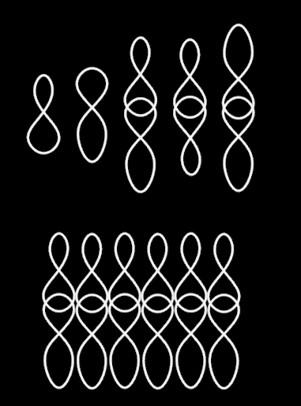
Avoiding nodes allows for the creation of a bigger print as the weight is distributed and surface tension is created in a bigger expansion. You can compare the size of the following two prints. One with nodes and one without.
Comments
Post a Comment